


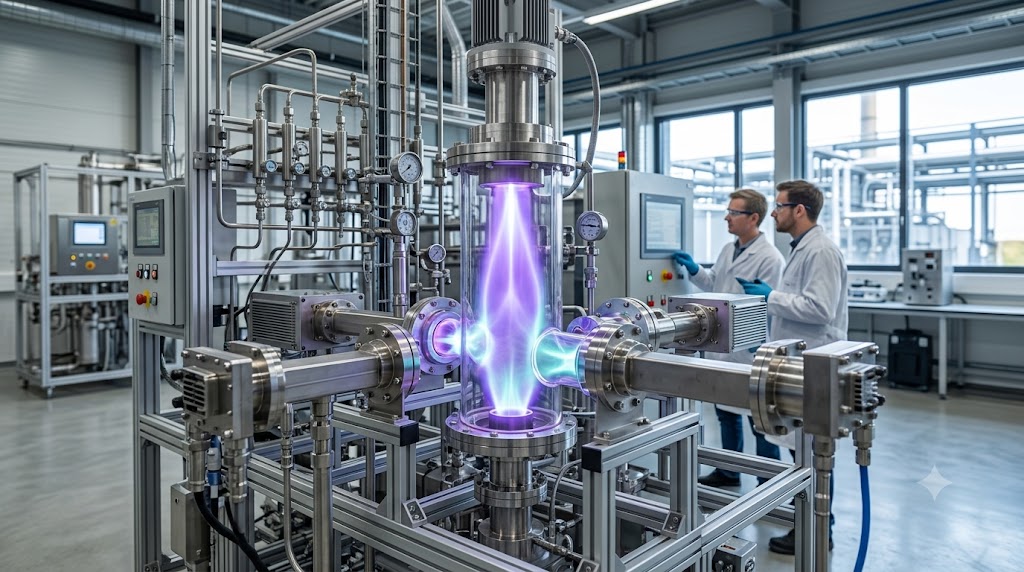
The industrial sector accounts for nearly 30% of global greenhouse gas emissions, making decarbonization a critical priority for governments and manufacturers worldwide. Traditional methods of hydrogen production, metal processing, and material synthesis rely heavily on fossil fuels, contributing to significant carbon footprints. Microwave plasma technology is emerging as a game-changing solution that enables cleaner, faster, and more energy-efficient industrial processes.
Enerzi, a leading deep-tech engineering company based in India, is at the forefront of this revolution — developing advanced microwave plasma reactor designs and industrial microwave systems that are redefining how industries approach decarbonization.
What Is Microwave Plasma Technology?
Microwave plasma technology uses high-frequency electromagnetic waves (typically at 2.45 GHz) to ionize gases and create a plasma state at extremely high temperatures — often exceeding 5,000°C. Unlike conventional thermal systems, microwave plasma can be precisely controlled, offers rapid energy transfer, and operates with minimal heat loss.
This technology forms the backbone of several critical industrial processes:
- Methane Pyrolysis: Methane cracking for hydrogen and carbon nanoparticle production
- Metallurgy: Sintering, melting, and heat treatment of metals
- Material Synthesis: Advanced carbon nanomaterials and composites
- Waste Treatment: Decomposing harmful industrial by-products
How Microwave Plasma Methane Cracking Works?
Microwave plasma methane cracking is a process where natural gas (methane, CH₄) is decomposed into hydrogen (H₂) and solid carbon — without producing any CO₂ emissions. This makes it a breakthrough zero-emission hydrogen technology.
The Process Step-by-Step
- Methane gas is fed into a specially designed microwave plasma reactor.
- Microwave energy ionizes the gas, creating a high-temperature plasma zone.
- The methane molecules (CH₄) are split into hydrogen gas (H₂) and solid carbon nanoparticles.
- Hydrogen is captured for industrial use; carbon is collected as a valuable by-product.
Comparison: Hydrogen Production Methods
| Method | Raw Material | CO₂ Emissions | Energy Efficiency | By-Product |
| Steam Methane Reforming (Grey) | Natural Gas | High (10-12 kg CO₂/kg H₂) | 65-75% | CO₂ |
| Electrolysis (Green) | Water + Electricity | Zero (if renewable) | 60-70% | Oxygen |
| Microwave Plasma Methane Cracking | Natural Gas | Zero | 70-85% | Solid Carbon (valuable) |
| Coal Gasification (Brown) | Coal | Very High | 45-55% | CO₂, Ash, Slag |
Industrial Applications of Microwave Plasma Technology
1. Metallurgy and Metal Processing
Microwave plasma for metallurgy enables faster and more uniform heating compared to conventional furnaces. Applications include sintering of powder metals, heat treatment of steel and alloys, melting of specialty metals, and surface hardening. The microwave sintering system achieves up to 80% energy savings compared to conventional electric furnaces while delivering superior material properties.
2. Clean Hydrogen Production
As discussed, microwave plasma methane cracking produces hydrogen without CO₂ emissions. This positions it as a vital pathway for industries seeking zero-emission hydrogen technology, particularly in refineries, ammonia production, and fuel cell applications.
3. Carbon Nanoparticle Manufacturing
The solid carbon by-product from methane cracking is high-purity carbon nanoparticles — a valuable material used in batteries, composites, rubber reinforcement, and advanced coatings. Plasma-synthesized carbon nanoparticles have superior quality compared to traditional furnace-produced carbon black.
4. Industrial Drying and Heating
Industrial microwave systems provide rapid, volumetric heating for food processing, pharmaceuticals, ceramics, and chemical processing. Unlike conventional heating (outside-in), microwave heating works inside-out, resulting in faster processing times and lower energy consumption.
Must Read : Energy Efficient Industrial Heating Using Microwave Systems
Why Choose Microwave Plasma for Industrial Decarbonization?
| Feature | Conventional Systems | Microwave Plasma Systems |
| Carbon Emissions | High | Zero/Near-Zero |
| Energy Efficiency | 50-70% | 70-85% |
| Heating Speed | Slow (hours) | Fast (minutes) |
| Process Control | Limited | Precise & Automated |
| By-products | CO₂, waste gases | Solid carbon (valuable) |
| Scalability | Moderate | Modular & Scalable |
| Maintenance | High | Low |
Microwave Plasma Reactor Design: Key Considerations
Designing an effective microwave plasma reactor requires deep expertise in microwave engineering, materials science, and process chemistry. Key design factors include:
- Waveguide Configuration: Must efficiently guide microwave energy to the plasma zone with minimal reflection losses.
- Reactor Chamber Materials: Reactor materials must withstand extreme temperatures (>3,000°C) while remaining transparent to microwaves.
- Power Supply Design: Power levels typically range from 1 kW for lab-scale to 100+ kW for industrial applications.
- Gas Flow Dynamics: Gas flow rates, pressure, and composition determine plasma stability and product quality.
- Control Systems: Advanced sensors and automation enable real-time process optimization.
Enerzi, as a leading plasma engineering company and custom microwave system manufacturer, designs and builds complete microwave plasma solutions tailored to specific industrial requirements.
The Role of Enerzi in Industrial Decarbonization
Enerzi is one of India’s pioneering deep-tech energy startups, specializing in three interconnected verticals:
- Clean Hydrogen: Producing zero-emission hydrogen through microwave plasma methane cracking
- Nanocarbon: Manufacturing high-purity carbon nanoparticles as a valuable by-product
- Microwave Technology: Designing and building custom industrial microwave and plasma systems
With in-house R&D capabilities, manufacturing facilities, and a team of specialized engineers, Enerzi delivers end-to-end industrial decarbonization solutions — from concept to deployment.
Conclusion
Microwave plasma technology represents a paradigm shift in how industries can achieve sustainability goals without compromising on productivity or quality. By enabling zero-emission hydrogen production, energy-efficient heating, and high-value carbon by-products, this technology is setting the standard for next-generation industrial processes.
As global regulations tighten and carbon pricing becomes inevitable, early adopters of microwave plasma solutions will gain a significant competitive advantage. Enerzi stands ready to partner with manufacturers, refineries, and energy companies to accelerate the transition to a decarbonized industrial future.